

GSSE Pass Rates: What Every Candidate Needs to Know

Explore GSSE pass rates, key insights, and strategies to improve your chances of success. Understand how the exam is marked to focus your preparation.
Introduction
The General Surgical Sciences Examination (GSSE) is a tough, early gateway on the surgical training journey. Even though you're armed with all of the resources, the pathway through can at times feel overwhelming and opaque.
The statistics show a sobering truth: pass rates remain consistently tough, often hovering around 60%. During preparation, it is therefore essential to understand how the exam is marked, why some candidates struggle, and how you can overcome this hurdle.
How the GSSE is Marked
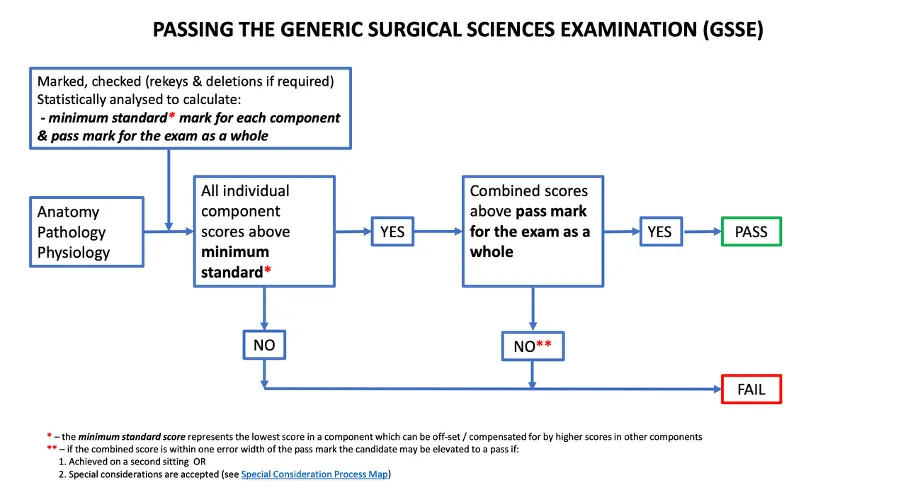
To pass the GSSE, candidates must meet two key requirements:
- Component pass: Reach the minimum required score in each of the three sections — Anatomy, Pathology, and Physiology.
- Overall pass: Achieve the minimum combined score across all three sections.
If you fail any single component, you fail the exam — regardless of your overall score. This ensures that candidates demonstrate an acceptable level of knowledge across all core sciences.
Weightings are approximately:
- Anatomy: 50%
- Pathology: 25%
- Physiology: 25%
Minimum passing scores are adjusted slightly each year to reflect exam difficulty while maintaining standards.
Example from past sitting:
Below are the minimum required component scores from the June 2024 sitting:
- Anatomy: 58.2%
- Pathology: 59.8%
- Physiology: 62.4%
Whereas the overall required score was 65.1%.
What Is a “Minimum Standard Pass”?
A candidate who meets all three minimum component score requirements but fails to meet the overall score requirement will fail the examination.
However, the candidate may be eligible for a Minimum Standard Pass (MSP) in a subsequent examination if their overall score is within one error width of the required minimum. They will be elevated to a pass (minimum standard) only if they achieve this level again at a later attempt.
Insights from Recent GSSE Pass Rates
Let’s take a look at recent pass rate data:
2023
- Overall: 59.6%
- NZ: 70.3% | AU: 59.6%
- First attempt: 69.3% | Second attempt: 44.8% | Third attempt: 26.8%
2022
- Overall: 60.7%
- NZ: 67.7% | AU: 58.9%
- First attempt: 71.5% | Second attempt: 48.7% | Third attempt: 41.4%
2021
- Overall: 59.8%
- NZ: 80.3% | AU: 56.6%
- First attempt: 71.1% | Second attempt: 40.1% | Third attempt: 38.7%
Key Lessons
- Pass rates are consistently higher for first-time candidates (~70%) compared with repeat sitters.
- Second and third attempts see dramatic drops, some as low as 26%.
- Despite year-to-year variation, overall pass rates remain close to 60%.
Why Do Candidates Struggle?
The GSSE is designed to assess core surgical sciences knowledge, but many candidates underestimate the depth required. Common pitfalls include:
- Focusing too narrowly on anatomy and neglecting pathology/physiology
- Leaving past questions to the last minute
- Lack of practice under exam-style timed conditions
- Poor benchmarking of progress before the real exam
- Delaying preparation because they are unsure how to begin
Practical Takeaways for Candidates
If you’re preparing for the GSSE, here are actionable strategies:
- Aim to pass first time — maximise preparation for your initial sitting, since later attempts carry lower success rates.
- Balance your study — pathology and physiology together make up 50% of the exam.
- Use evidence-based learning techniques — spaced repetition and active recall are proven to improve long-term retention.
- Practice under exam conditions — timed practice exams reduce anxiety and build stamina.
- Benchmark your progress — trial exams (such as those run by Prof Julie Mundy) and digital question banks like Get-Thru provide critical feedback.
- Start today — Last’s Anatomy can feel like a herculean task, but even a few questions each day helps transition into exam mindset.
Conclusion
The GSSE is a demanding but achievable milestone. With overall pass rates sitting around 60%, the exam is designed to challenge — but not defeat — committed candidates who prepare well.
Success depends on early, structured preparation, balancing all three sections, and using the right tools: past papers, benchmarking, and high-quality question banks.
.